Viksit Bharat@2047
Viksit Bharat @2047
CLASS NOTES |
By- Santosh Kashyap
Faculty of IR
@Bihar Naman Gs
For: 71st & 72nd BPSC Mains Class
Date: 20.03.2026
Introduction
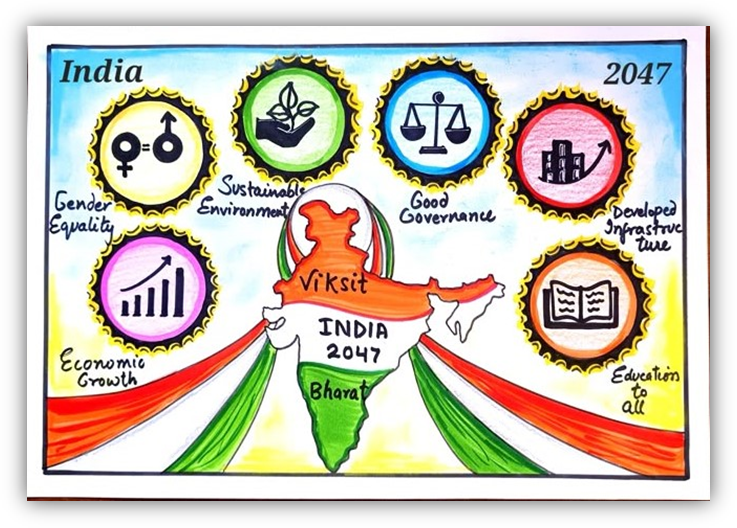
When India had its "Tryst with Destiny" on August 15, 1947, the goal was to break colonial shackles. However, the goal for August 15, 2047, is to establish India as a "leading superpower" on the global stage. Viksit Bharat 2047 (Developed India 2047) is not merely an administrative target; it is a civilizational resurrection. This vision document is a bold resolve to make India a $30 trillion economy and bring per capita income at par with developed nations.
"Viksit Bharat 2047" is a grand dream and resolution of Prime Minister Narendra Modi. He believes that when India completes 100 years of independence, our country should be at the forefront of the world's richest and most powerful nations. The PM launched this mission on December 11, 2023, emphasizing four main pillars (G.Y.A.N.) to make it successful:
- G - Garib (Poor): Whose standard of living must be improved.
- Y - Yuva (Youth): Who are the future of the country.
- A - Annadata (Farmers): Who feed the nation.
- N - Nari Shakti (Women Power): Who will lead the development.
Let’s understand this in detail from both the Indian and Bihar perspectives.
Main Body
Chapter 1: The Four Impregnable Pillars of Viksit Bharat (GYAN)
According to the Prime Minister's vision, the edifice of Developed India rests on four main pillars. The strengthening of these pillars will determine the destiny of the country:
1.1 Poor: The Right to a Dignified Life
- The goal of "Zero Poverty" is not limited to increasing income. It includes eliminating Multidimensional Poverty (MPI).
- JAM Trinity: Ending middlemen through financial inclusion via Jan Dhan-Aadhaar-Mobile.
- PM Awas Yojana: By 2047, every Indian will have their own permanent (pucca) house, toilet, electricity, and tap water.
1.2 Youth: Pioneers of Innovation
- 65% of India's population is in the working-age group. This "Demographic Dividend" is India's greatest weapon.
- New Education Policy (NEP) 2020: Shifting from a culture of rote learning to a focus on research and skills.
- Atal Tinkering Labs: Developing a mindset of patents and innovation at the school level.
1.3 Annadata: The Hub of Global Food Security
- The goal is to make India the "Food Basket of the World."
- Digital Agriculture Mission: Freedom from middlemen through drone technology, AI-based crop forecasting, and e-NAM.
- Natural Farming: Increasing soil fertility and export potential by moving away from chemicals.
1.4 Nari Shakti: Women-Led Development
- When 70% of women participate in economic activities, India's GDP will automatically increase by 20-25%.
- Nari Shakti Vandan Adhiniyam: Direct participation of women in policy-making.
- Lakhpati Didi Scheme: Transforming the rural economy through Self-Help Groups (SHGs).
Chapter 2: Economic Transformation & Budget 2025-26 Milestones
To reach $30 trillion by 2047, India must maintain a consistent growth rate of 8-9%. Budget 2025-26 has laid the foundation:
- Income Tax Reform: Increasing the tax exemption limit to ₹12 lakh is a strategic move. It leaves more disposable income with the middle class, driving demand and manufacturing.
- MSME & Startup Ecosystem: India is the world’s 3rd largest startup ecosystem. The goal is to reach number 1.
- FDI & Trade: Through "Make in India" and "PLI Schemes," India is becoming an alternative to the global supply chain. The arrival of Apple, semiconductor companies, and Tesla are major signals.
Chapter 3: Infrastructure and Digital Revolution
Physical and digital infrastructure is the backbone of any developed nation.
- PM Gati Shakti: Aiming to reduce logistics costs from 14% of GDP to below 8% by 2047 through the integration of rail, road, water, and air.
- Digital Public Infrastructure (DPI): UPI, Aadhaar, and DigiLocker have made India a global digital leader. 40% of the world's digital transactions happen in India.
Chapter 4: Health, Education, and Social Empowerment
- Health for All: Expansion of Ayushman Bharat and the Digital Health Mission (Health IDs).
- Education 4.0: Aiming for Indian universities to be in the global top 100 by 2047.
Chapter 5: Energy Security and Environmental Sustainability
- Panchamrit Goal: Net-zero emissions by 2070; meeting 50% of energy needs from renewables by 2047.
- Green Hydrogen Mission: A major step toward making India an energy exporter.
Chapter 6: National Security and Global Leadership (Vishwa Mitra)
- Defense Self-reliance: Exporting indigenous weapons like Tejas, INS Vikrant, and BrahMos.
- Space Superpower: ISRO’s Gaganyaan and Chandrayaan missions.
- Soft Power: Global peace through Yoga, Ayurveda, and Indian culture.
Chapter 7: Challenges and the Path to Solutions
- Regional Inequality: Solved via the "Aspirational Districts Program."
- Climate Change: Solved via Disaster Resilient Infrastructure (CDRI).
- Judicial Reforms: Solved via digitization of courts and simplification of legal processes.
Central Budget 2026-27: Special Provisions for Viksit Bharat @2047
Theme: "Empowered Citizen, Capable Nation"
1. Common Man and Taxation
- Tax Relief: The income tax exemption limit of up to ₹12 lakh for the middle class has been retained.
- Standard Deduction: The standard deduction limit for salaried individuals has been increased, leading to a rise in take-home salaries.
- Simplified Process: An AI-based system has been launched for filing Income Tax Returns (ITR), eliminating paperwork and ensuring faster refunds.
2. Agriculture and Farmers
- Digital Agri-Stack: Every farmer is being provided a 'Digital Identity Card' (Agri-ID). This ensures direct and immediate transfer of funds for fertilizers, seeds, and government schemes into their accounts.
- Storage Scheme: The world’s largest grain storage chain is being built in villages to prevent crop wastage and allow farmers to sell when prices are favorable.
- Natural Farming: Financial assistance has been announced to transition 1 crore additional farmers to 'chemical-free' natural farming.
3. Employment & Skills for Youth
- Internship Program 2.0: One crore youth will be given the opportunity to intern at the country's top companies. They will receive a monthly stipend, half of which will be funded by the government.
- Affordable Education Loans: 'Skill Loans' at very low interest rates have been introduced for higher education and technical courses.
- Boosting Startups: The 'Angel Tax' has been completely abolished for young entrepreneurs to ensure easier access to investment.
4. Infrastructure
- Amrit Bharat Stations: Over 1,000 railway stations will be modernized to match the standards of international airports.
- Electric Vehicles (EV): To reduce pollution, a target has been set to install charging stations every 25 kilometers on National Highways.
- Affordable Air Travel: Under the 'UDAN' scheme, 50 new airports and helipads will be developed in smaller cities.
5. Women's Empowerment
- Lakhpati Didi Scheme: Skill training and market access will be provided to transform 3 crore women associated with Self-Help Groups (SHGs) into 'Lakhpati Didis.'
- Women’s Hostels: A special budget has been allocated for safe hostels for working women in major cities and the establishment of creches (daycare centers).
6. Special Provisions for Bihar
- Flood Protection: Large-scale water management projects have been approved to prevent flooding from the Kosi and other rivers.
- Industrial Corridor: A major industrial hub is being developed in Gaya to provide local manufacturing jobs for the youth of Bihar.
- Tourism: Heavy investment in infrastructure will be made to transform Rajgir, Bodhgaya, and Vaishali into 'World-Class Tourism Destinations.'
7. Technology and the Future
- AI Mission: New centers will be opened to establish India as a Global Hub for Artificial Intelligence.
- Affordable Internet: The 'Bharat Net' scheme has been expanded to bring 5G and future 6G technology to rural villages.
Bihar Budget 2026-27: Key Provisions for Viksit Bharat @2047
1. Jobs & Startups (Employment and Entrepreneurship)
- Job Creation: A dedicated fund has been allocated in the budget to create new positions and fill existing vacancies across various government departments within the next year.
- Startup Bihar: The 'Seed Fund' (initial assistance) for young entrepreneurs starting their own businesses has been increased. Interest-free loans will now be more accessible.
- IT Hubs: Budgetary support has been provided for the construction of new IT Parks in areas like Bihta and near Patna to curb brain drain and provide local opportunities for youth.
2. Agriculture & Rural Development
- Agriculture Roadmap 4.0: Under the fourth agriculture roadmap, specialized 'Processing Units' will be established to boost the export of Makhana (fox nuts), Mangoes, and Litchis.
- Irrigation Facilities: Significant investment has been earmarked for the "Har Khet Tak Pani" (Water to Every Field) scheme, focusing on new tube wells and the restoration of old canals.
- Digital Panchayat: A target has been set to transform villages into 'Smart Villages' by connecting all state panchayats with high-speed internet.
3. Infrastructure and Connectivity
- Expressways: Funds have been allocated to accelerate work on Bihar’s first expressway (Amas-Darbhanga) and other proposed expressway projects.
- Bridges and Roads: The 'Mukhyamantri Gram Sampark Yojana' has been expanded to link rural areas with main highways.
- Metro and Airports: Specific funds have been granted for the timely completion of the Patna Metro and the expansion of Bihta and Purnea airports.
4. Education & Health
- New Medical Colleges: Announcements have been made to open new medical colleges and hospitals in districts that currently lack such facilities.
- Digital Classrooms: The budget for equipping government schools with smart classrooms and computer labs has been increased.
- Research: A separate 'Research Grant' system has been established to promote research within state universities.
5. Women Welfare (Empowerment)
- Jivika Didis: Jivika (SHG) groups are being integrated into the economy as Banking Correspondents and through small-scale industries, such as solar light assembly.
- Kanya Utthan Yojana: Adequate funds have been secured to provide incentive amounts to female students pursuing higher education.
6. Tourism & Culture
- Heritage Development: A network of roads and hotels will be developed to transform historical centers like Rajgir, Bodhgaya, Vaishali, and Sasaram into 'World-Class Tourism Hubs.'
- Ganga River Front: Following the Patna model, 'River Fronts' will be developed in other cities situated along the riverbanks.
7. Disaster Management
- Flood Control: To find a permanent solution to the flood problem in North Bihar, new projects for river linking and strengthening embankments near the Nepal border will commence.
Conclusion
Viksit Bharat 2047 does not just mean shining roads and buildings; it means a smile and self-respect on the face of every Indian. It is a dream of an India where poverty is a thing of the past, technology serves humanity, and India leads the world as a "Vishwa Mitra" (Friend of the World).